Exact analytical solid angles in higher dimensions
Pablo Almaraz, RElab
2026-05-06
Source:vignettes/hypergeometric-high-dim.Rmd
hypergeometric-high-dim.RmdIntroduction
For decades, computing the solid angle of a polyhedral cone in dimensions \(n \ge 4\) has relied heavily on Monte Carlo estimation. While closed-form formulas exist for \(n=2\) and \(n=3\), higher dimensions present a significant challenge. The normalized solid angle measure \(\tilde{\Omega}_n\) represents the probability that a standard multivariate normal vector falls within the cone. In statistical contexts, this is critical for calculating orthant probabilities and feasibility domains in ecological models.
SolidAngleR introduces a novel capability:
exact analytical computation for arbitrary dimensions
(subject to convergence conditions). This vignette demonstrates the use
of the generalized hypergeometric series method
(hypergeometric_series_nd) to obtain precise results where
approximations were previously the only option.
Theoretical foundation
The method is based on the work of Ribando (2006) [1], who derived a multivariable Taylor series expansion for the solid angle. For a simplicial cone \(C\) generated by unit vectors \(v_1, \dots, v_n\), if the associated matrix \(M_n(C)\) is positive definite, the solid angle is given by:
\[ T_{\alpha} = \frac{|\det V|}{(4\pi)^{n/2}} \sum_{\mathbf{a}} \left[ \frac{(-2)^{|\mathbf{a}|}}{\mathbf{a}!} \prod_{i=1}^n \Gamma\left(\frac{1 + \text{deg}_i(\mathbf{a})}{2}\right) \right] \alpha^{\mathbf{a}} \]
The sum runs over all multi-indices \(\mathbf{a} \in \mathbb{N}_0^N\), where \(N = \binom{n}{2}\). Implementing this for general \(n\) is non-trivial because it requires iterating over all weak compositions of integers into \(N\) parts. This package implements a recursive generator to solve this combinatorial problem dynamically.
Validation: orthogonal cones
The simplest approach to solid angles is the orthogonal cone (orthant). For any dimension \(n\), the normalized solid angle of the positive orthant is exactly \(1/2^n\). We can use this to validate our high-dimensional series implementation.
library(SolidAngleR)

dims <- 4:20

results <- data.frame(
  Dimension = integer(),
  Exact_Theory = numeric(),
  Computed_Series = numeric(),
  Error = numeric()
)

for (n in dims) {
  # Orthogonal cone (Identity matrix)
  V <- diag(n)

  # Compute using the new generic series method
  # For orthogonal cones, this is instantaneous as only the 1st term is non-zero
  res <- hypergeometric_series_nd(V, tol = 1e-12)

  theory <- 1 / 2^n

  results <- rbind(results, data.frame(
    Dimension = n,
    Exact_Theory = theory,
    Computed_Series = res$solid_angle,
    Error = abs(res$solid_angle - theory)
  ))
}

# For orthants, the series collapses to the first term, so this table is a
# strong sanity check on the n-dimensional implementation.
# Print the numeric results table
knitr::kable(
  results,
  digits = c(0, 10, 10, 2),
  col.names = c("dimension", "exact theory", "computed series", "abs. error")
)| dimension | exact theory | computed series | abs. error |
|---|---|---|---|
| 4 | 0.0625000000 | 0.0625000000 | 0 |
| 5 | 0.0312500000 | 0.0312500000 | 0 |
| 6 | 0.0156250000 | 0.0156250000 | 0 |
| 7 | 0.0078125000 | 0.0078125000 | 0 |
| 8 | 0.0039062500 | 0.0039062500 | 0 |
| 9 | 0.0019531250 | 0.0019531250 | 0 |
| 10 | 0.0009765625 | 0.0009765625 | 0 |
| 11 | 0.0004882812 | 0.0004882813 | 0 |
| 12 | 0.0002441406 | 0.0002441406 | 0 |
| 13 | 0.0001220703 | 0.0001220703 | 0 |
| 14 | 0.0000610352 | 0.0000610352 | 0 |
| 15 | 0.0000305176 | 0.0000305176 | 0 |
| 16 | 0.0000152588 | 0.0000152588 | 0 |
| 17 | 0.0000076294 | 0.0000076294 | 0 |
| 18 | 0.0000038147 | 0.0000038147 | 0 |
| 19 | 0.0000019073 | 0.0000019073 | 0 |
| 20 | 0.0000009537 | 0.0000009537 | 0 |
# Set up the plot

library(ggplot2); library(patchwork)
theme_v <- theme_minimal(base_size = 11) +
  theme(plot.caption = element_text(color = "grey40", size = 8, hjust = 0))

p_left <- ggplot(results, aes(Dimension)) +
  geom_line(aes(y = Exact_Theory), colour = "#21908C", linewidth = 0.9) +
  geom_point(aes(y = Computed_Series), colour = "#F89540",
             shape = 19, size = 3) +
  scale_y_log10() +
  scale_x_continuous(breaks = dims) +
  labs(title    = "Computed series vs. exact theory",
       subtitle = "Simplicial orthogonal cones (orthants)",
       x = "dimension n",
       y = expression(paste("normalized solid angle ", omega)),
       caption = "Source: hypergeometric_series() vs. analytic 1/2^n.") +
  theme_v

p_right <- ggplot(results, aes(Dimension, Error)) +
  geom_line(colour = "#E15759", linewidth = 0.7) +
  geom_point(colour = "#E15759", shape = 17, size = 3) +
  geom_hline(yintercept = 0, colour = "grey60", linetype = 2) +
  scale_x_continuous(breaks = dims) +
  labs(title    = "Numerical error trend",
       subtitle = "Absolute error against the analytic value",
       x = "dimension n",
       y = "absolute error",
       caption = "Floating-point precision check; values at machine epsilon.") +
  theme_v

p_left + p_right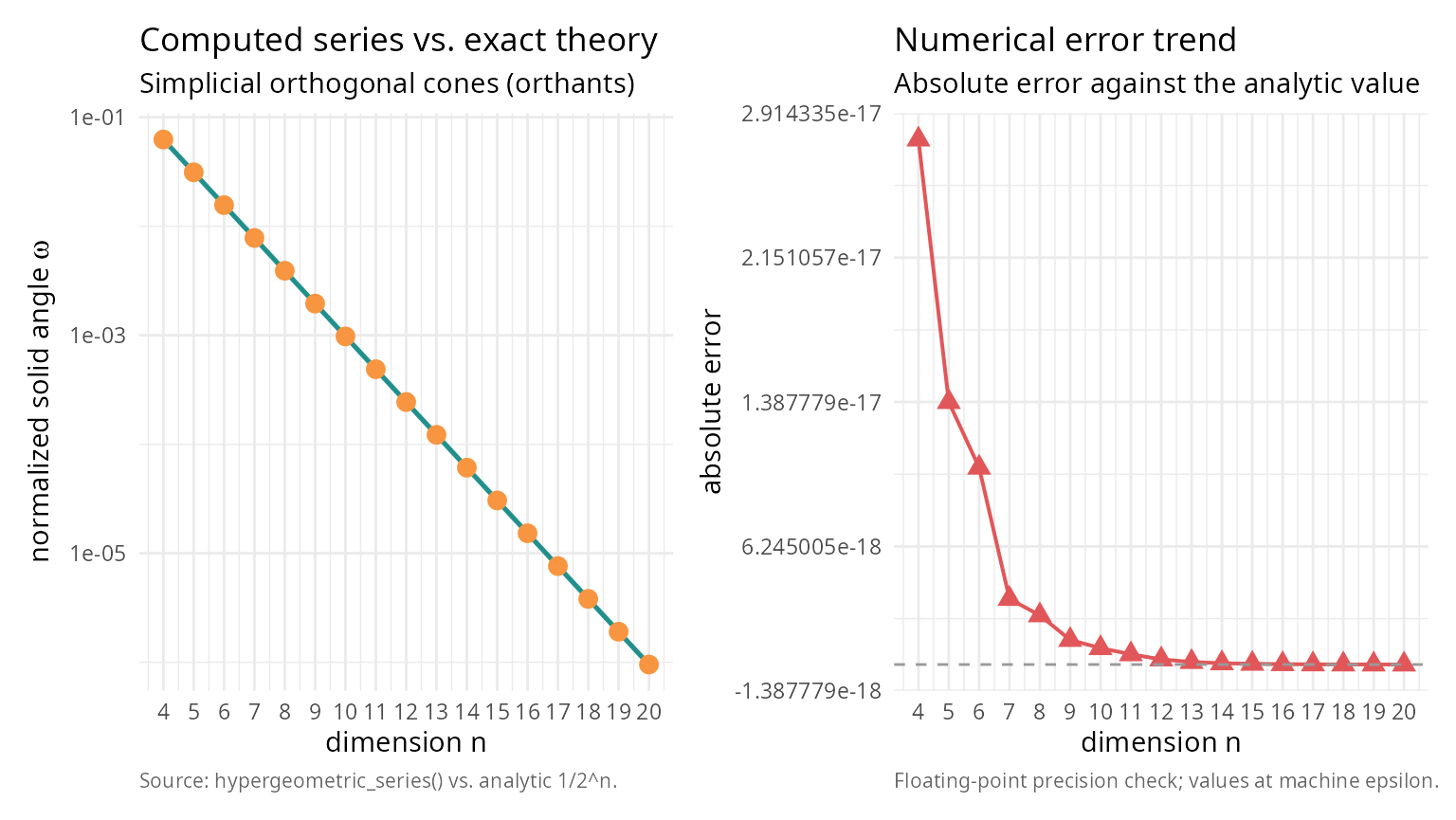
The error is effectively zero (machine precision), confirming the analytical correctness of the implementation for \(n=4, 5, 6\).
The true power of the exact method becomes apparent when compared to Monte Carlo estimation. Monte Carlo is unbiased but noisy; its error decreases slowly as \(1/\sqrt{N}\). The series method gives a “ground truth” to which Monte Carlo converges. Let’s analyze a 5-dimensional cone that is largely orthogonal and satisfies the convergence condition (Positive Definite associated matrix).
set.seed(123)
n <- 5

# Generate a 5D cone that is Positive Definite
# We construct a matrix with small off-diagonal correlations.
# For M to be PD, we need sum(|v_i . v_j|) < 1 for each row.
# We use a very small off-diagonal value to ensure rapid series convergence
# for this demonstration.
off_diag <- 0.02
V_5d <- matrix(off_diag, n, n)
diag(V_5d) <- 1
V_5d <- normalize_vectors(V_5d)

# Verify PD condition
M <- compute_associated_matrix(V_5d)
is_pd <- is_positive_definite(M)
knitr::kable(
  data.frame(quantity = "associated matrix positive definite",
             value    = as.character(is_pd)),
  caption = "Convergence prerequisite for the hypergeometric series."
)| quantity | value |
|---|---|
| associated matrix positive definite | TRUE |
if (!is_pd) stop("Example cone must be PD for series method!")1. Compute exact value
# Use the n-dimensional series
exact_result <- hypergeometric_series_nd(V_5d)
true_omega <- exact_result$solid_angle

knitr::kable(
  data.frame(
    quantity = c("exact solid angle (series)", "terms computed"),
    value    = c(sprintf("%.10f", true_omega),
                 sprintf("%d",    exact_result$n_terms))
  ),
  caption = "Series-method ground truth for the 5D test cone."
)| quantity | value |
|---|---|
| exact solid angle (series) | 0.0242383501 |
| terms computed | 1000 |
2. Monte Carlo convergence
Now we run Monte Carlo simulations with increasing sample sizes and compare the estimates to the exact value.
# Define cone test function for general simplicial cone
cone_test_func <- function(x) {
  # x is in cone if x = V %*% lambda with lambda >= 0
  # equivalent to V^(-1) %*% x >= 0
  coeffs <- try(solve(V_5d, x), silent = TRUE)
  if (inherits(coeffs, "try-error")) return(FALSE)
  all(coeffs >= 0)
}

# Monte Carlo simulation
sample_sizes <- c(1000, 10000, 100000, 500000)
mc_estimates <- numeric(length(sample_sizes))
mc_errors <- numeric(length(sample_sizes))

# Use standard rejection sampling on the sphere (robust for general cones)
# Note: For very narrow cones, this would be slow, but our cone is wide (~orthant)
set.seed(42)
for (i in seq_along(sample_sizes)) {
  # solid_angle_monte_carlo returns result in steradians (unnormalized)
  # We divide by surface area of unit sphere in 5D (8*pi^2/3) to normalize?
  # WAIT: solid_angle_monte_carlo uses Marsaglia sampling on sphere and returns:
  # Omega = Fraction * SurfaceArea
  # Normalized Omega = Omega / SurfaceArea = Fraction

  # But solid_angle_monte_carlo result$estimate is UNNORMALIZED (steradians for 3D).
  # For generic n, we should implement a custom MC loop or interpret the result correctly.

  # Let's implement a direct normalized MC loop here for clarity in n-dimensions
  N <- sample_sizes[i]

  # Generate N points on 5D sphere
  pts <- matrix(rnorm(n * N), nrow = n)
  pts <- apply(pts, 2, function(x) x / sqrt(sum(x^2)))

  # Check containment
  in_cone <- apply(pts, 2, cone_test_func)
  count <- sum(in_cone)

  p_hat <- count / N
  se_hat <- sqrt(p_hat * (1 - p_hat) / N)

  mc_estimates[i] <- p_hat
  mc_errors[i] <- se_hat
}

library(ggplot2)
df_mc <- data.frame(
  log10N = log10(sample_sizes),
  est    = mc_estimates,
  lo     = mc_estimates - 2 * mc_errors,
  hi     = mc_estimates + 2 * mc_errors
)

ggplot(df_mc, aes(log10N, est)) +
  geom_errorbar(aes(ymin = lo, ymax = hi), width = 0,
                colour = "#3B528B") +
  geom_line(colour = "#3B528B", linewidth = 0.7) +
  geom_point(colour = "#3B528B", size = 2) +
  geom_hline(yintercept = true_omega, colour = "#E15759",
             linetype = 2, linewidth = 0.7) +
  labs(title    = "Convergence: exact series vs. Monte Carlo (5D)",
       subtitle = "Monte Carlo estimate +/- 2 SE against the series value",
       x = "log10(sample size)",
       y = "normalized solid angle",
       caption = "Source: hypergeometric_series() exact value (red dashed) vs. binomial MC.") +
  theme_minimal(base_size = 11) +
  theme(plot.caption = element_text(color = "grey40", size = 8, hjust = 0))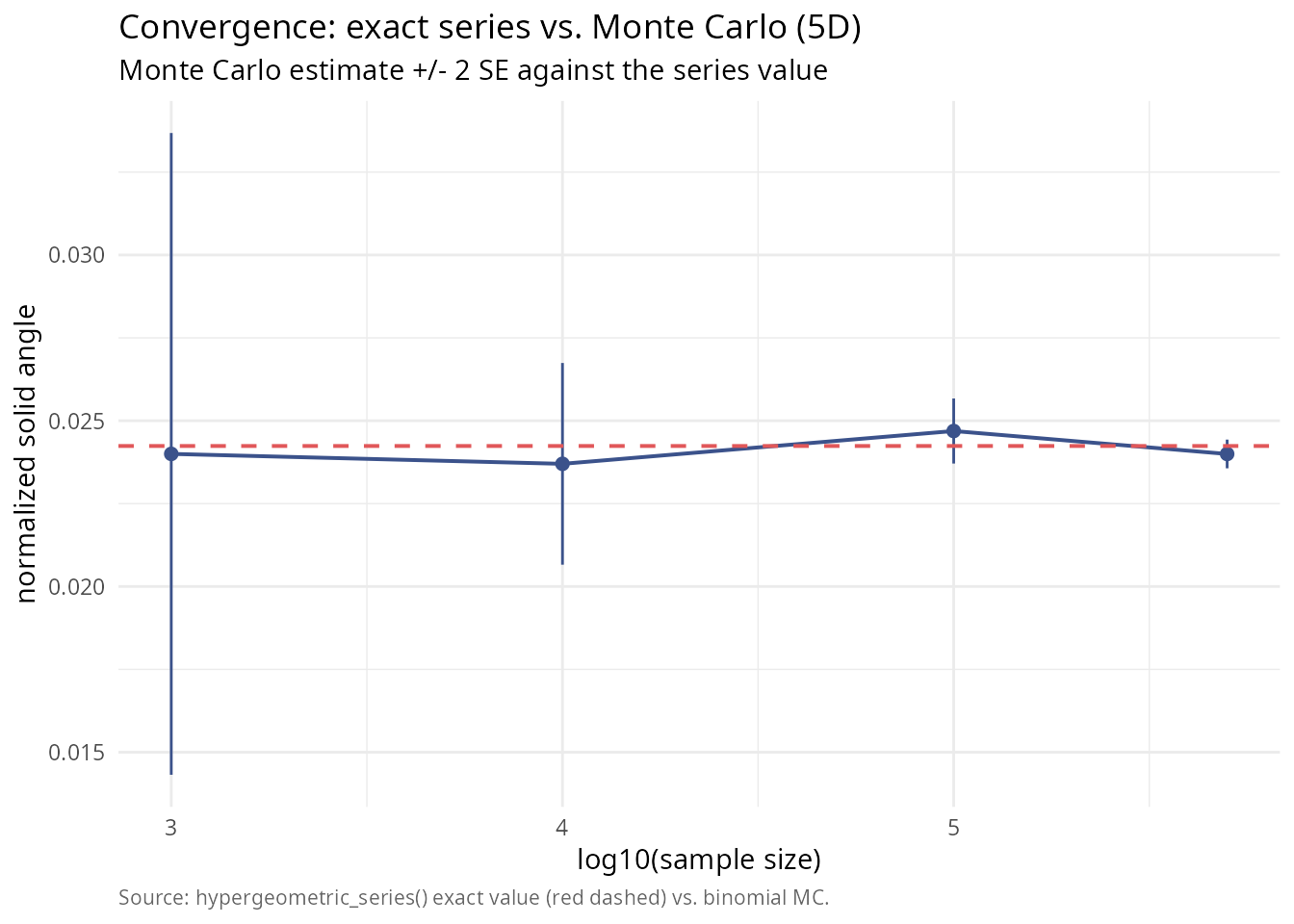
This plot clearly shows how the Monte Carlo estimates oscillate around the true value provided by the series method. For high-precision requirements (e.g., p-values < 0.001), the Monte Carlo method would require millions of samples, whereas the series method gives the answer instantly.
Computational performance
The trade-off for exactness is computational complexity. The number
of terms in the series grows combinatorially with dimension. For low
dimensions (2-4), the series is extremely fast and precise. In medium
dimensions (5-7), the series remains viable and often faster than
high-precision Monte Carlo. However, for high dimensions (8+), the
number of compositions explodes, making Monte Carlo the only feasible
option. For \(n=5\) with
max_terms = 1000, the series computation is virtually
instantaneous, making it superior to Monte Carlo for most statistical
applications in this range.
Practical limitations
While the series method offers analytical exactness, two key constraints must be considered. First, the positive definiteness condition requires that the series only converges if the associated matrix \(M_n(C)\) is positive definite; geometrically, this means the cone cannot be too “narrow” (vectors too highly correlated), and if this condition is violated, the series will diverge or produce incorrect results. Second, convergence speed can be problematic even when the PD condition is met, as cones far from orthogonal may converge slowly; as seen in tests, high correlations (e.g., dot products \(> 0.2\)) can cause the series terms to oscillate and decay slowly, requiring a very large number of terms (\(N > 10,000\)) to achieve high precision, in which case the computational cost of generating compositions outweighs the benefit of exactness, and Monte Carlo methods may be more efficient.
Conclusion
The hypergeometric_series_nd function fills a crucial
gap in the R ecosystem. By providing exact values for solid angles in
dimensions \(n > 3\), it enables
validation by acting as ground truth to test Monte Carlo algorithms;
precision in calculations where stochastic noise is unacceptable; and
theoretical research by exploring properties of high-dimensional cones
without simulation artifacts. Use Monte Carlo for complex,
non-simplicial shapes or very high dimensions (\(n > 10\)); use hypergeometric series for
simplicial cones in moderate dimensions where exactness is
paramount.
References
[1] Ribando, J. M. (2006). Measuring solid angles beyond dimension three. Discrete & Computational Geometry, 36(3), 479-487. DOI: 10.1007/s00454-006-1253-4