Robust Ecologies Lab

← Back to research

Structural stability of invasion graphs for Lotka–Volterra systems.

A C1-perturbation sets in,
a global attractor
resists the push

Structural stabilityLotka-VolterraMorse-SmaleInvasion graphsGlobal attractorsStability

Pablo Almaraz, Piotr Kalita, José A. Langa, Fernando Soler–Toscano (2024) Structural stability of invasion graphs for Lotka–Volterra systems. Journal of Mathematical Biology 88: 64, DOI: 10.1007/s00285-024-02087-8

Cite
BibTeX
@article{Almaraz2024,
  author = {Almaraz, Pablo and Kalita, Piotr and Langa, José A. and Soler–Toscano, Fernando},
  title = {{Structural stability of invasion graphs for Lotka–Volterra systems}},
  journal = {Journal of Mathematical Biology},
  volume = {88},
  number = {6},
  pages = {64},
  year = {2024},
  doi = {10.1007/s00285-024-02087-8},
  publisher = {Springer Science and Business Media LLC}
}
RIS
TY  - JOUR
AU  - Almaraz, Pablo
AU  - Kalita, Piotr
AU  - Langa, José A.
AU  - Soler–Toscano, Fernando
TI  - Structural stability of invasion graphs for Lotka–Volterra systems
T2  - Journal of Mathematical Biology
PY  - 2024
VL  - 88
IS  - 6
SP  - 64
DO  - 10.1007/s00285-024-02087-8
UR  - https://doi.org/10.1007/s00285-024-02087-8
PB  - Springer Science and Business Media LLC
ER  - 
APA

Almaraz, P., Kalita, P., Langa, J. A., & Soler–Toscano, F. (2024). Structural stability of invasion graphs for Lotka–Volterra systems. Journal of Mathematical Biology, 88(6), 64. https://doi.org/10.1007/s00285-024-02087-8

Authors
Affiliations

ICMAN-CSIC

Piotr Kalita

Jagiellonian University

José A. Langa

Universidad de Sevilla

Fernando Soler–Toscano

Universidad de Sevilla

Published

June 2024

Live: Lotka-Volterra competition among three species whose interaction matrix is Volterra-Lyapunov stable (its symmetric part has eigenvalues 1.8, 0.6 and 0.6). Species 3 cannot invade the other two (invasion rate −0.14), and every orbit that starts with all three present converges to the equilibrium (0.59, 0.82, 0); the boundary equilibria and the connections between them form the invasion graph.

Abstract

In this paper, we study in detail the structure of the global attractor for the Lotka–Volterra system with a Volterra–Lyapunov stable structural matrix. We consider the invasion graph as recently introduced in Hofbauer and Schreiber (J Math Biol 85:54, 2022) and prove that its edges represent all the heteroclinic connections between the equilibria of the system. We also study the stability of this structure with respect to the perturbation of the problem parameters. This allows us to introduce a definition of structural stability in ecology in coherence with the classical mathematical concept where there exists a detailed geometrical structure, robust under perturbation, that governs the transient and asymptotic dynamics.

Important figure

This figure should have appeared in the published paper, but it didn’t. A mystery.
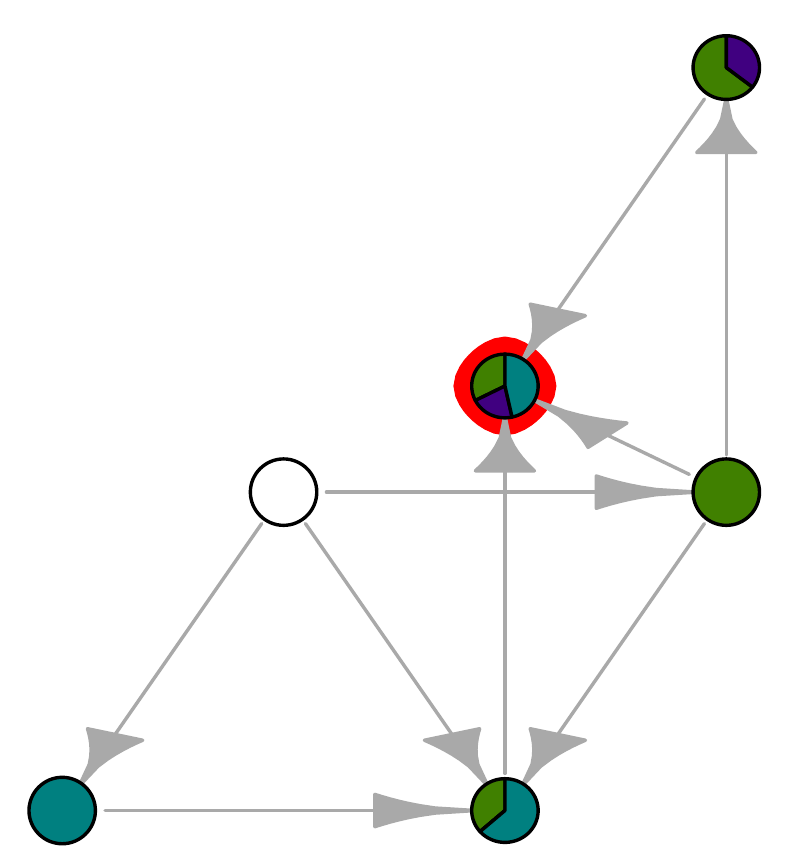
Figure : Global attractor for the example of an ecological community with three species. Given that the matrix is Volterra–Lyapunov stable, the global attractor is identical to the invasion graph. The open circle is the empty community, u∗ = (0, 0, 0), and the circle surrounded by a red ring is the GASS. The three different colors of the solutions denote the identity of each species, and the pie chart represent the relative abundance of each species in that particular stationary solution. In this case, the GASS represents a feasible community (all species are present), u∗ = (0.2633778, 0.1695335, 0.377100).

Citation

 Add to Zotero

@article{Almaraz2024,
  title = {Structural Stability of Invasion Graphs for {{Lotka}}--{{Volterra}} Systems},
  author = {Almaraz, Pablo and Kalita, Piotr and Langa, Jos\'e A and Soler--Toscano, Fernando},
  date = {2024-06-17},
  journaltitle = {Journal of Mathematical Biology},
  volume = {88},
  number = {6},
  pages = {64},
  doi = {10.1007/s00285-024-02087-8}
}